

Natural stone in indoor and outdoor residential spaces

Choosing materials for your home and everyday life is an act of foresight. And aesthetics are just the beginning of the decision-making process.
In the collective imagination, people often tend to categorize stones as “beautiful” or “less beautiful.” In reality, we at the Consorzio Marmisti della Valpantena prefer a different distinction: appropriate stones and less appropriate stones.
In this article, we will explore how to turn the choice of stone into a lasting investment, analyzing where and how to best use it in residential settings, balancing aesthetic taste with technical requirements.
A guide to choosing between aesthetics and performance
1. The first choice: indoor or outdoor
Location is the fundamental starting point. A stone that looks stunning in a living room might not be the ideal choice for a driveway exposed to the elements.
- Outdoors, stone must adapt to its location (sunny, shaded, sheltered, etc.) and its orientation relative to the cardinal directions, and it must withstand harsh weather conditions. Stresses such as rain, snow, and freeze-thaw cycles (depending on the building’s location) require materials with excellent structural strength. In these cases, frost resistance and anti-slip properties can prove to be the key factors.
- Indoors, the stresses are generally milder, but variables related to daily life come into play, such as wear from foot traffic and contact with household substances. One of the properties to evaluate in this case is resistance to chemical stresses.
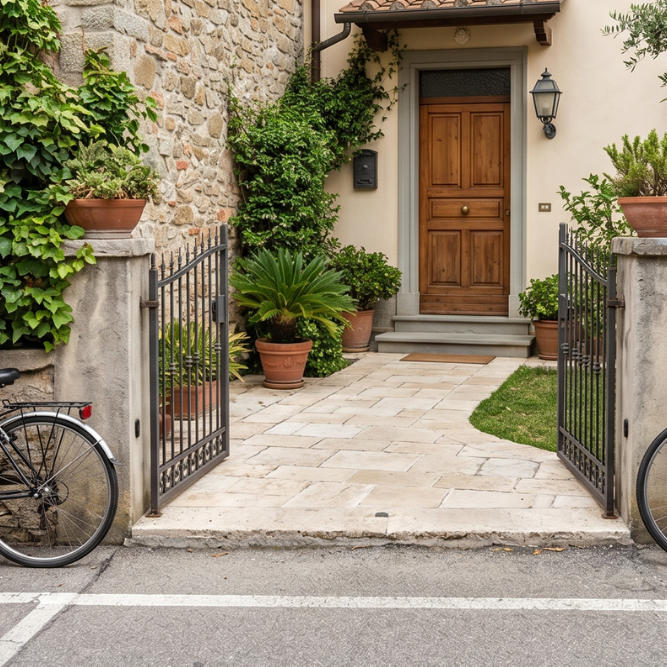
2. Flooring: differences based on the entryway
Not all floors are subjected to the same wear and tear. Consider the difference between a fifth-floor apartment and a house in the countryside, by the sea, or in the mountains.
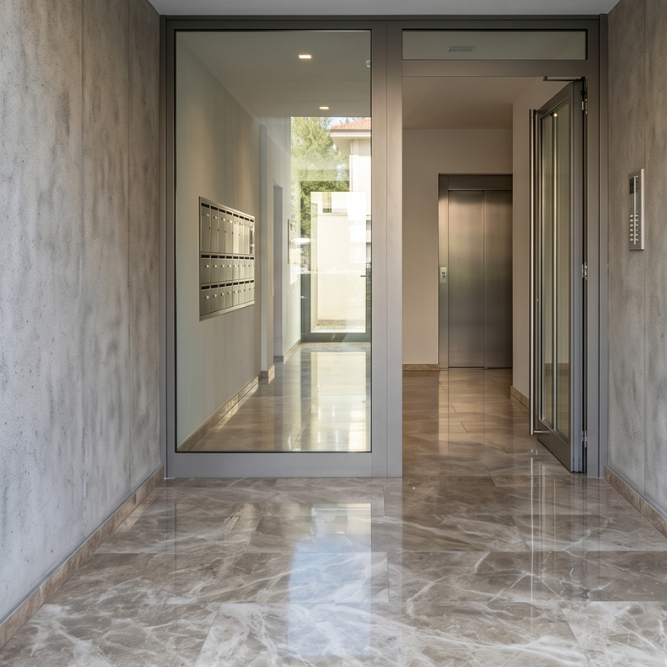
- The floor in the entryway of an apartment on a high floor is subject to less abrasive wear, because anyone entering has already wiped their shoes clean along the building’s common areas.
- The floor of a street-facing house is exposed to debris, sand, and road salt (depending on the home’s location), and in these cases, abrasion resistance becomes the number one technical parameter to prevent the surface’s shine from fading prematurely.
3. Stairs: where design ,meets safety
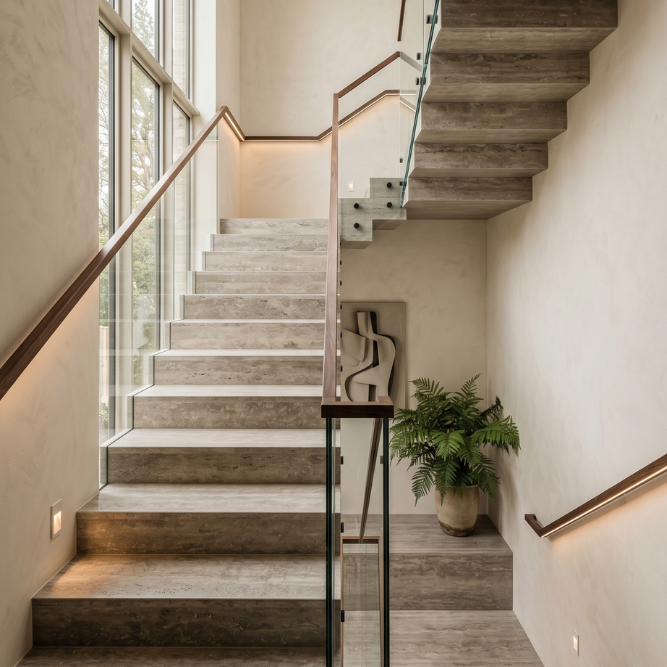
Made of natural stone, a staircase is not merely a connection between floors, but a true monumental sculpture that stands the test of time. As an element of vertical circulation, it requires specific considerations:
- wear resistance: the tread is subject to constant, localized friction, so choosing materials with excellent abrasion resistance prevents the step from wearing down in the center after just a few years, maintaining the flatness necessary for safety;
- finish: especially for outdoor stairs or those located in entryways prone to moisture, the surface finish is crucial. Flamed or bush-hammered finishes for outdoor use (which ensure excellent grip even in the rain); matte polishing for indoor elegance;
- technical details: the choice of stone also influences the construction method. A freestanding staircase requires materials with very high flexural strength, while for cladding on reinforced concrete there is greater aesthetic freedom, allowing for continuous veining that flows from one step to the next.
4. The kitchen: the beating (and chemical) heart of the home
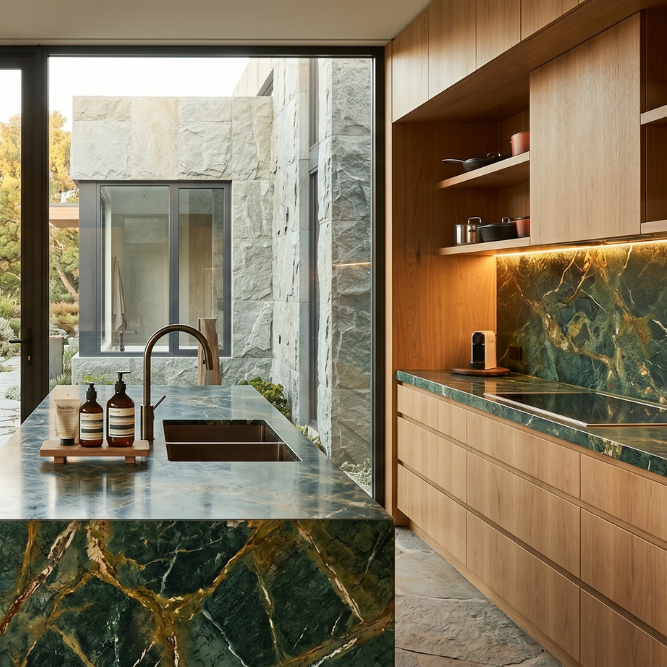
The kitchen countertop and the dining area floor are the battlegrounds of everyday life. Between accidentally dropping a glass (impact) and contact with certain foods or harsh cleaning agents (chemical attack), stone must be chosen with care.
For kitchen countertops, opt for high-density stones or those treated with finishes that guarantee water resistance, ensuring that function never has to sacrifice form.
5. The bathroom: wellness and durability
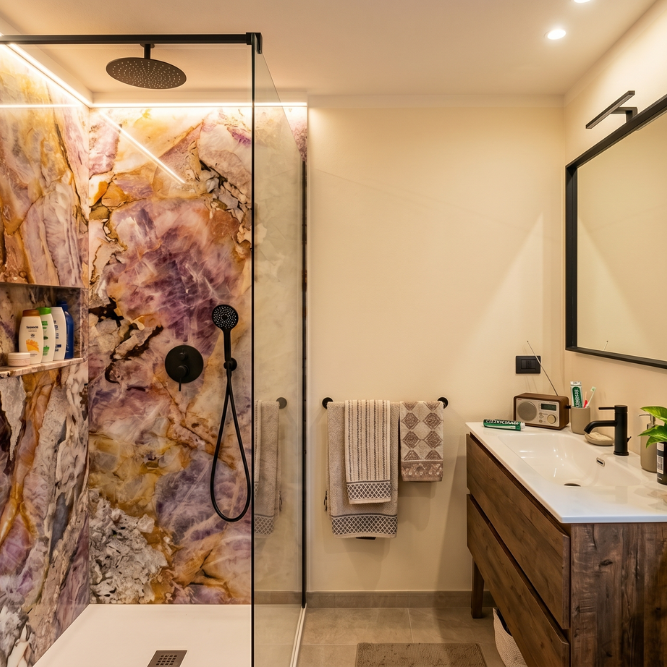
In the bathroom, natural stone transforms the space into a private spa. However, constant exposure to personal hygiene products and limescale requires materials with good chemical resistance. Finishes such as brushing or polishing not only offer an extraordinary tactile experience but can also make maintenance easier when properly matched to the nature of the stone itself.
6. Sustainability and longevity: the timeless investment
A technical fact that is often overlooked is that natural stone is the only material whose lifespan exceeds that of the building itself. Choosing it means:
- reducing the need for future replacements;
- embracing a material that ages gracefully, gaining character over time;
- optimizing the project’s life cycle (LCA), an issue increasingly central to modern eco-sustainable architecture.
The secret to a successful project is not the “perfect” stone in absolute terms, but rather the one with the characteristics best suited to its specific use. Our role as a Consortium is to guide you through this intersection of geology and design.
Contact us for more information.


Contact us
We are at your disposal, below you will find our contact details.
We are waiting for you.
Consorzio Marmisti della Valpantena
P.IVA 01707830236 - REA VR-191854

