

Every stone has its own identity card

How to choose the right natural stone for your project
When choosing natural stone for a project, it is not enough to be guided solely by colour, veining or aesthetic appeal. These elements are important, as they define the visual character of a space. However, to make a truly informed and confident choice, you need further information: the technical characteristics of the stone. Each type of stone behaves differently. Some stones are better suited to high-traffic flooring, others to interior cladding, whilst others are ideal for outdoor use, staircases, kitchen worktops or areas prone to damp.
This should not be a cause for concern. On the contrary, it is precisely thanks to this information that stonemasons, designers and technicians can recommend the most suitable material for the intended use, avoiding mistakes and ensuring a beautiful, functional and durable result.
What are the technical characteristics of natural stone?
Technical characteristics are the set of details that enable us to understand how a stone behaves under specific conditions.
They tell us, for example, how the stone reacts:
- to contact with water;
- to chemical agents;
- to frost;
- to sudden changes in temperature;
- to foot traffic;
- to impact;
- to compression;
- to bending;
- to wear and tear over time.
In other words, technical characteristics help us to understand whether a stone is suitable for a particular application. It is one thing to choose a material for an indoor wall cladding. It is quite another to choose it for outdoor paving, a staircase, a bathroom, a kitchen worktop or a façade. Every environment has different requirements, and every stone responds differently.
The "identity card" of natural stone
A simple way to understand the value of technical characteristics is to think of them as a sort of identity card for natural stone. Just as an identity document provides information about a person, technical characteristics allow you to identify a stone in terms of its performance; this way, you can understand how it will behave, depending on where you intend to use it.
Seeking out this information is useful because it allows you to:
- gain a better understanding of the material;
- compare different stones;
- assess their suitability for the intended use;
- make your choice with greater confidence and awareness;
- prevent problems during use.
For this reason, when you rely on an expert stonemason, the choice is never made simply "by eye". Beauty remains fundamental, but it is accompanied by a specific technical assessment that is essential for a successful final result.
Similar stones are not always the same
One of the most common misconceptions is to assume that stones with the same name, colour or composition automatically have the same characteristics. Two stones may belong to the same family, look similar or contain similar minerals, but they may behave differently when subjected to certain stresses.
To understand this concept, we can draw a comparison with people. Two individuals of the same age, the same sex or with similar physical characteristics will not necessarily have the same blood test results. Every organism has its own history and structure, and responds differently depending on the situation.
Something similar happens with natural stone. Each material has its own internal structure, formed over time through specific geological processes. And it is precisely this structure that influences its behaviour, strength, absorption, durability and suitability for use. That is why natural stone should not be generalised; it must be understood.
The main technical characteristics to consider
Technical characteristics can be grouped into a few broad categories. The end customer does not need to know all of them in detail, but it is useful to understand their general significance in order to appreciate why the support of a professional is so important.
1. Petrographic characteristics
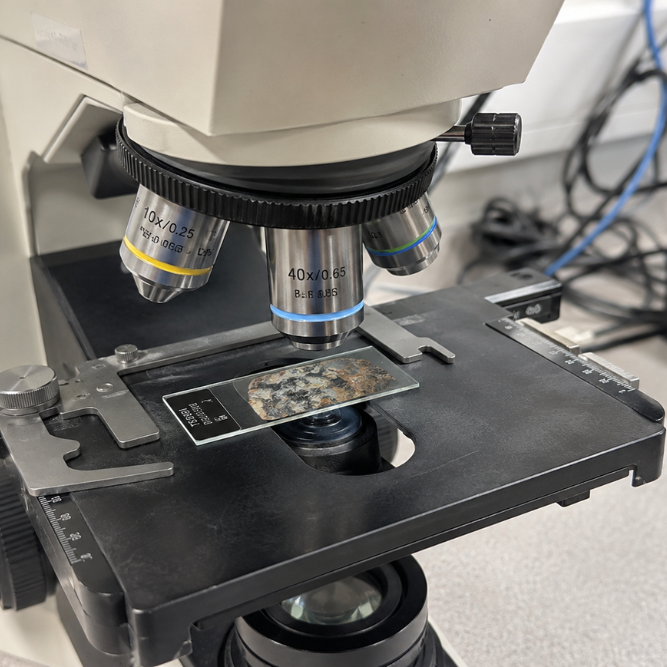
Petrographic characteristics reveal the true nature of the stone. Through microscopic analysis, it is possible to observe features that are invisible to the naked eye, such as:
- minerals present;
- grain size of the material;
- microdiscontinuities;
- voids;
- state of preservation of the roc;
- internal structure.
This information is useful because it helps to understand the material’s actual composition and how it might behave over time. It provides an "in-depth" analysis of the stone, which is particularly useful when the material is to be used in technically sensitive contexts.
2. Physical and mechanical properties of natural stone
This category includes some of the most important information for assessing the performance of stone. These include, for example:
- Weight and porosity: weight and the presence of internal voids are interrelated factors. A more porous stone may be lighter, whilst a more compact stone may be heavier. But bear in mind: a porous stone is not automatically unsuitable. It always depends on the intended use.
- Water absorption: all stones absorb water, to varying degrees. Therefore, this factor becomes particularly important in damp environments, outdoor areas, bathrooms, kitchens or areas subject to frost. A proper assessment of water absorption allows you to choose the most suitable material and, if necessary, the most appropriate finish or treatment.
Mechanical properties: these indicate how the stone reacts to specific stresses. Some examples:
- compressive strength, useful when the stone has to bear loads;
- flexural strength, important for elements that may be subjected to bending;
- impact resistance, useful for assessing behaviour in the event of falling objects;
- abrasion resistance, essential for floors and high-traffic surfaces.
It is therefore not enough to simply say that a stone is durable.
One must always ask: durable against what? (read more on this topic in this article).
3. Durability characteristics of natural stone
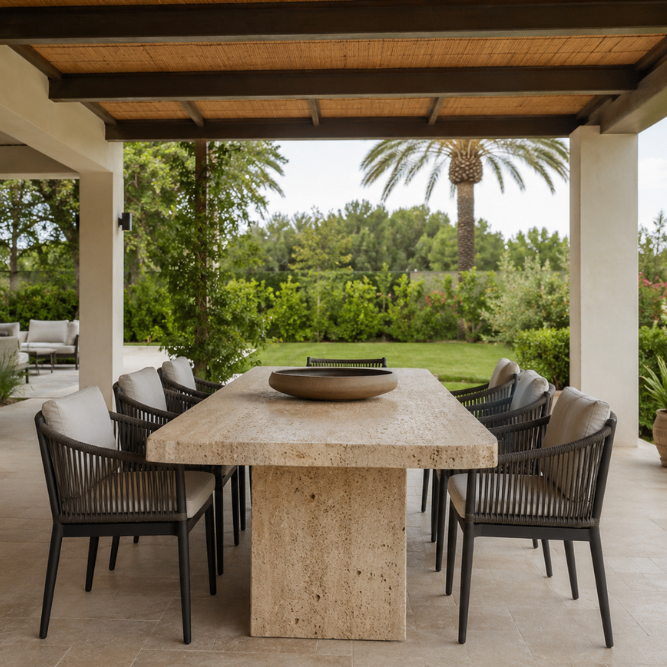
Durability refers to a stone’s ability to retain its technical, aesthetic and mechanical properties over time. It is particularly important when the material is exposed to weathering agents such as rain, frost, pollution, chemicals, damp and temperature fluctuations.
A durable stone is one that retains its function and appearance over time, minimising degradation, loss of material or significant alterations. You will therefore appreciate that, in this case too, the assessment depends heavily on the intended environment. A stone used indoors will have different requirements to one exposed to the elements outdoors for years.
4. Technical characteristics of natural stone
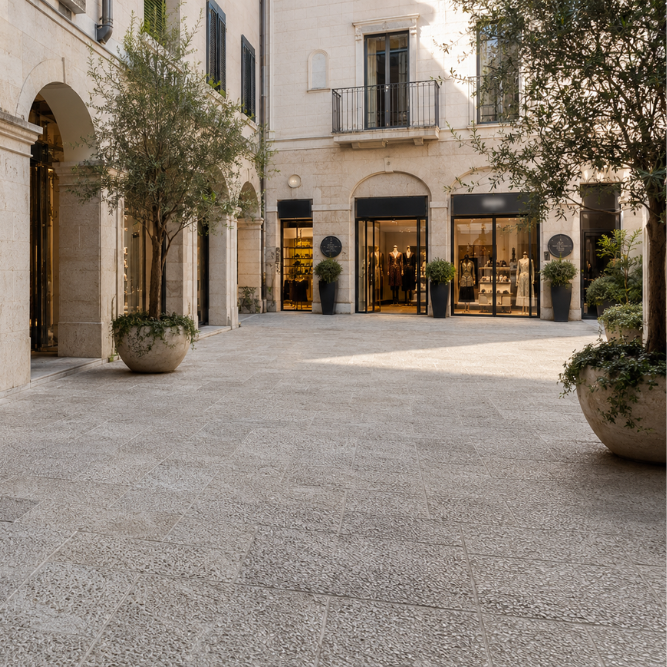
The technical characteristics relate to the interplay between the stone, its processing and its practical use. A very important example is slip resistance. Stone intended for use as flooring must also be assessed in terms of the risk of slipping, particularly if it is laid on ramps, stairs, pavements, entrances, in public spaces, on outdoor flooring or on surfaces that are often wet.
In this case, the surface finish is of paramount importance. A polished or honed surface will behave differently from a flamed, bush-hammered, sandblasted or split-face surface. For this reason, the stone must be tested and assessed in the same finish as that in which it will ultimately be installed (read more about stone finishes in this article).

Why consult a stonemason when choosing stone
For a private individual, an architect or a designer, navigating all this information can seem complicated. And this is precisely where the stonemason comes in. The stonemason knows the material, understands its characteristics, is familiar with the possible finishing techniques and can help identify the most suitable stone based on:
- intended use;
- installation environment;
- the desired finish;
- the aesthetic effect;
- the required performance;
- the expected maintenance;
- the budget.
The aim is not to complicate the choice, but to make it a more confident one. Technical specifications are not an obstacle: they are a tool to help you make a better choice. Natural stone offers extraordinary possibilities for architecture, interior design and everyday living. The key is to choose the stone best suited to your project, with the support of those who truly understand it.
Would you like to choose the natural stone best suited to your project?
Contact us: the companies of the Consorzio Marmisti della Valpantena can guide you in selecting the most suitable material, helping you to combine aesthetics, functionality and durability.


Contact us
We are at your disposal, below you will find our contact details.
We are waiting for you.
Consorzio Marmisti della Valpantena
P.IVA 01707830236 - REA VR-191854

