

Marble and Circularity: research, recovery and responsibility

The stone industry has reached a turning point. Growing environmental urgency requires a radical rethinking of the production cycle. The aim of this in-depth analysis is to present the state of the art and the most advanced results of scientific and industrial research on the recovery and recycling of marble processing waste, demonstrating how waste can become a resource with extremely high added value.
Powders, silts, sludges: materials once considered waste can become valuable resources for new products, thanks to technology, university research and synergies between companies. But what is the current state of the art? Where are we really at? What solutions are already available, and what issues still need to be resolved? In this article, we have compiled an up-to-date and authoritative overview of the main Italian projects dedicated to the reuse of stone waste.
Four cutting-edge projects, presented at a recent conference, outline a clear roadmap for the circular future of the sector.
Projects for the valorisation of waste dust from marble processing: the work of Prof. Roberta Bertani (University of Padua)
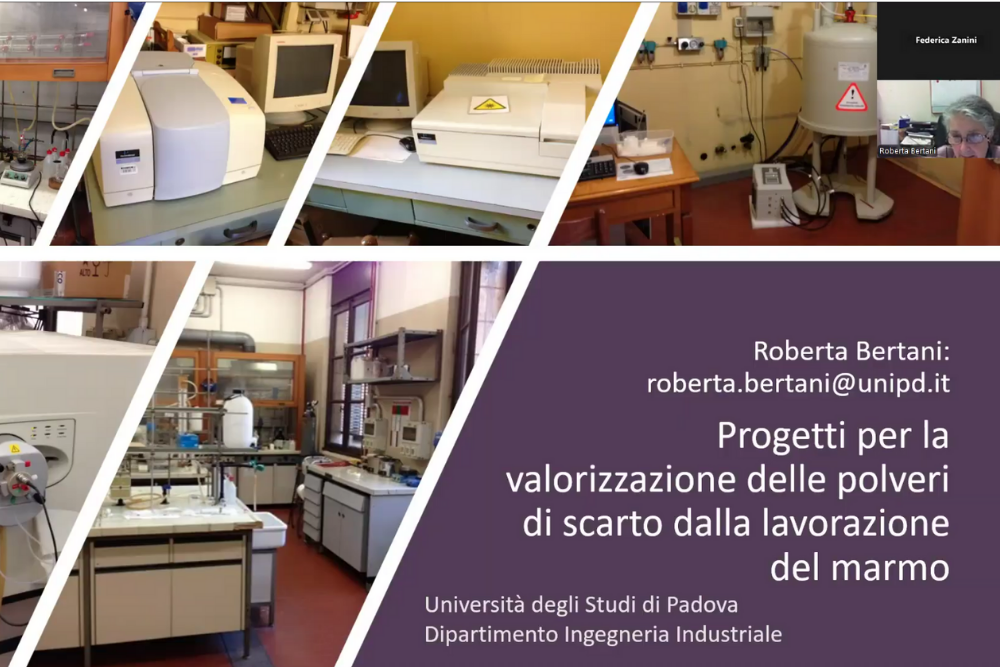
The first presentation at the conference was given by researcher Roberta Bertani from the Department of Industrial Engineering at the University of Padua.
Her presentation illustrated the results of a long process of study and experimentation, conducted in collaboration with us, the Valpantena Marble Workers’ Consortium, and Renato Dal Corso, aimed at enhancing the value of sludge and dust derived from marble processing.
These materials, which appear to be unusable, have proven to be rich in potential, both for their chemical characteristics and for the applications that can be derived from them.
Characterisation and industrial potential
The samples, taken from quarries in Vicenza, Verona and Carrara, were analysed for their chemical and mineralogical composition (calcite, quartz, dolomite) and particle morphology.
These data made it possible to test the use of calcium carbonate powders in numerous sectors:
- Additives for plastics, paints, paper and rubber.
- Polymer composites (epoxy resins) with improved mechanical properties.
- Building materials such as cement and asphalt.
- Pharmaceuticals, cosmetics and animal feed.
A significant example is its use in cement: the addition of these powders can improve compressive strength, making the material more efficient and sustainable.
Low-impact chemical reactions: green chemistry and CO₂ capture
However, the focus of the study is on a series of chemical reactions in water and at room temperature that can transform calcium carbonate into secondary compounds with high added value.
All processes involve capturing CO₂, which is then converted into other useful compounds. Among the products obtained are:
- Calcium chloride, used as a more environmentally friendly de-icing agent than common road salt.
- Potassium carbonate, used in fuel cells.
- Calcium nitrate and fluoride, precursors for lithium batteries.
- Sulphates, phosphates and acetates, with established uses in many industries.
A virtuous model of circular economy, where waste becomes a resource and every scrap is reused. An approach that demonstrates how the circularity of marble is not only an environmental option, but a geostrategic imperative for the supply of crucial elements, as indicated by Prof. Bertani’s analysis of the periodic table and the global scarcity of resources.
Towards industrialisation
The processes tested are replicable on an industrial scale, but require: clear regulations on end-of-waste, initial investments in processing plants, and a cultural shift to overcome mistrust of chemistry.
“We are talking about reactions in water, at room temperature, with pure and traceable materials. This is a real opportunity to generate value from what is currently a problem.”
Bertani recalled.
The University of Verona, ISIM and Verona Stone District: working together to develop an adhesive for the construction industry
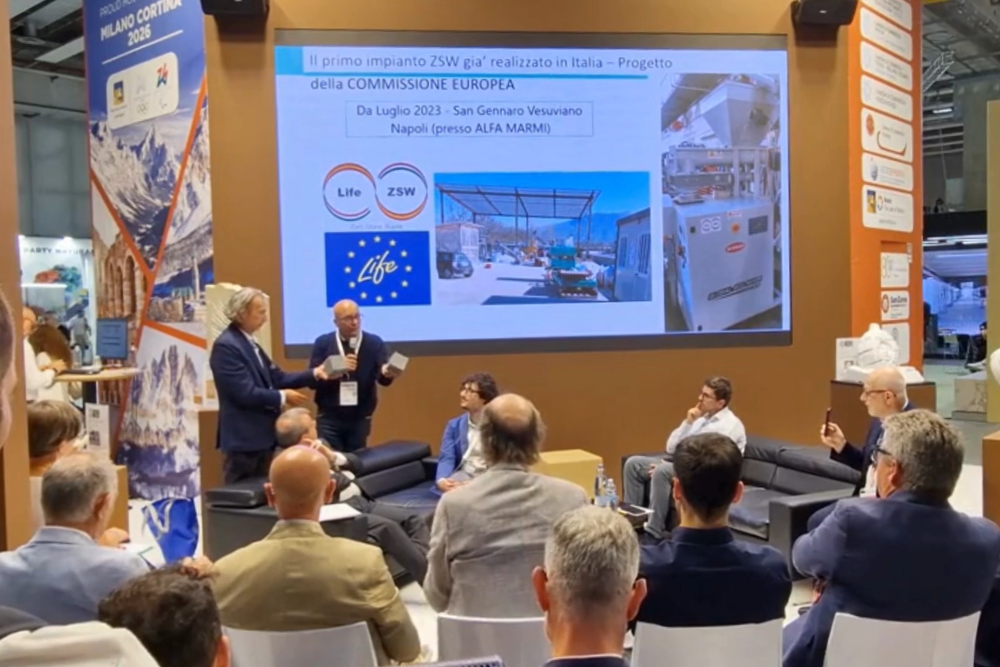
Alfa Marmi’s intervention brought an already active business case study. In collaboration with ISIM, the University of Verona and Verona Stone District, the company has launched a circular economy project.
Starting with two types of processing waste: sludge filtered through a filter press and crushed basalt shards (materials mainly used in the production plant), the company has created, through mixing, a construction adhesive with good mechanical performance, which is also in the process of being certified as a waterproofing material.
A replicable model
The Life ZSW project approach is designed to be replicable by other companies in the sector. To transform waste into a finished product, the process requires the use of specific equipment:
- Filter press: to separate water from sludge, reducing its volume and preparing it for further processing.
- Crusher: to grind and select the solid fragments to the required grain size;
- Mixer: to homogenise the ingredients, combining the liquid/slurry with the solid to create the final adhesive formulation.
The company has demonstrated concrete results, proving that it is possible to produce a high-quality building material from two by-products, thus closing the economic loop.
The bureaucratic challenge of “Non-Refusal”
A crucial aspect highlighted by the speaker was overcoming bureaucratic obstacles. Although the technical development of the product was rapid, the authorisation process took about a year and a half.
The delay was caused by the need to make the authorities and regulatory bodies understand that the operation did not consist of a mere “change of business activity“, but rather the manipulation and enhancement of the same products derived from the processing of natural stone, legally transforming them from waste to resources (the concept of End-of-Waste). This underlines once again how the desire to innovate inevitably clashes with the need to adapt and simplify regulations on the reuse of industrial by-products.
Artificial Intelligence at the service of recovery: projects by the University of Verona
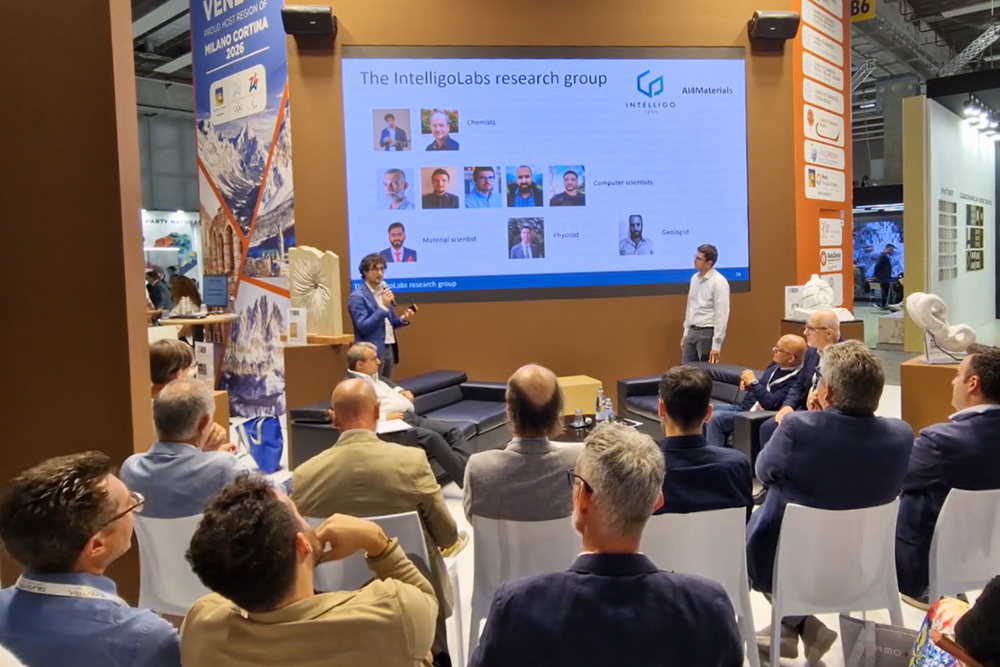
Dr Eros Radichi, from the University of Verona, presented a new research group established in 2024 with a clear objective: to address the issue of stone waste reuse with a multidisciplinary and integrated approach.
The team combines expertise in chemistry, geology, physics, computer science, artificial intelligence and materials science. It is a multidisciplinary team that works side by side to generate concrete results that can be applied by businesses, thanks to the combination of scientific, technological and operational skills.
Dr Radichi emphasised how the complexity of the issue requires real teamwork, where academic research is not an end in itself, but constantly dialogues with the needs of the local area and companies operating in the natural stone sector.
He then gave the floor to Prof. Setti, who illustrated the first project in detail.
Artificial intelligence at the service of processing sludge recovery
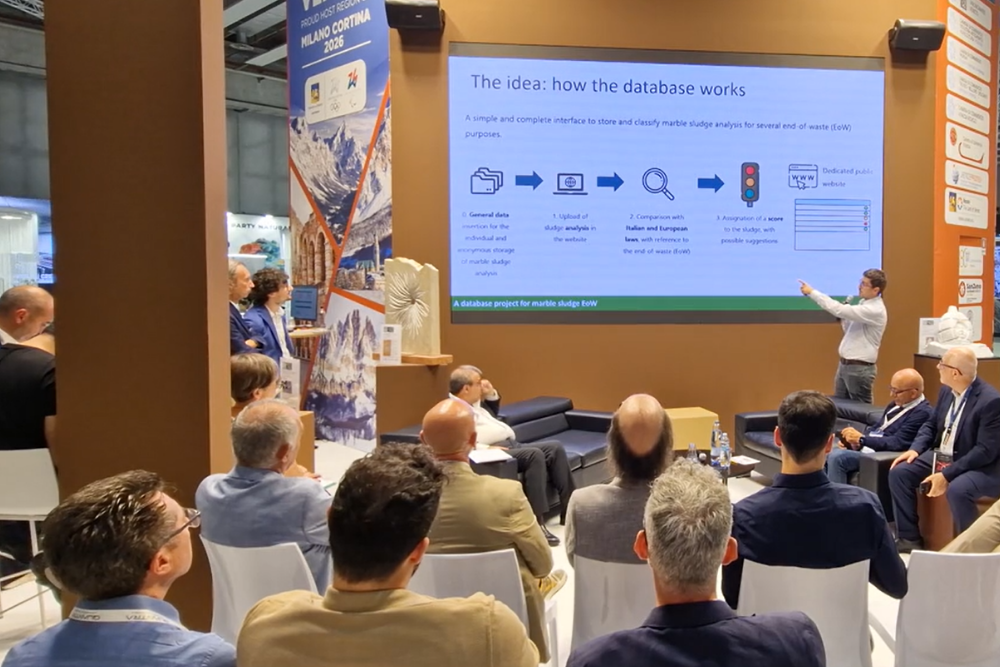
Professor Setti presented the project developed by the University of Verona research group, which was created with an ambitious goal: to reintegrate natural stone processing by-products into the circular economy, providing companies with concrete tools to do so.
The starting point was the study of three possible areas of application for processing residues, adhesives, asphalts and cements, with the aim of reducing waste and generating new products from sludge.
The first tangible result is the project developed together with ISIM and Alfa Marmi, which aims to create an intelligent database to help companies understand how to make the most of their sludge, starting with a chemical analysis of the by-product.
“The concept is simple, but very powerful: we can use data to uncover new possibilities, and do so automatically.“
explained Setti.
In fact, the system, developed with the university’s IT support, cross-references the metadata provided by companies (date, manufacturer, origin of the material) with the results of chemical analyses carried out by certified bodies.
On this basis, artificial intelligence processes the data and analyses Italian and European regulations to return an immediate result in the form of a “traffic light“:
- Green, if the material can be reused in compliance with regulations;
- Yellow, if some modifications or optimisations are necessary;
- Red, if the conditions for reuse do not currently exist.
Companies will thus be able to understand in real time what uses are possible for their sludge, or how to combine it with other materials to comply with legal parameters. The system, accessible via the web and currently in phase 2 of development, will be able to suggest optimal combinations of by-products to obtain new sustainable materials.
A key aspect of the project is privacy: all data is anonymised, but if the algorithm identifies a possible useful “match“ between two companies, it will be possible, with prior consent, to activate a direct communication channel, thus promoting real collaborations and new industrial opportunities.
Finally, Professor Setti demonstrated a further evolution of the system, tested with Alfa Marmi: thanks to artificial intelligence, it is possible to predict the mechanical behaviour of the material based solely on chemical analysis. Initial tests have already made it possible to estimate the porosity of the samples with a high degree of accuracy, paving the way for a new generation of predictive tools for the stone industry.
FinalLap: new avenues for processing limits
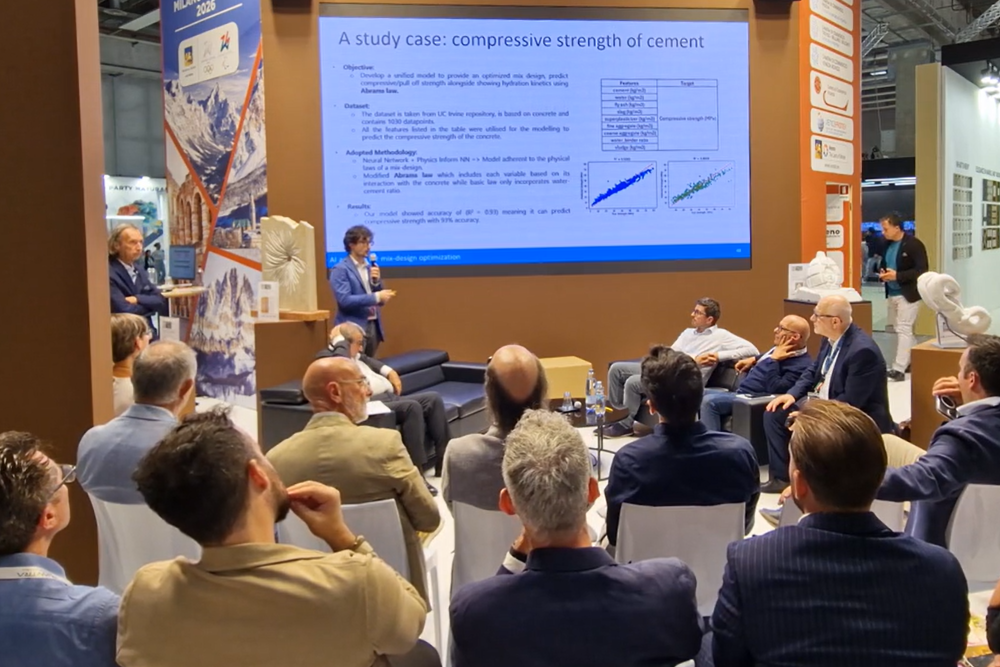
Continuing his overview of ongoing projects, Dr Radichi presented FinalLap, an initiative funded by the Cariverona Foundation that explores an innovative use for natural stone processing sludge: its reuse as a by-product for the construction of road sub-bases.
An ambitious project, structured in four operational phases:
- Territorial mapping: the first step involved scanning the territory of Verona and Vicenza to quantify the scope of the phenomenon and the availability of residual materials.
- Regulatory analysis: the second phase involved a careful assessment of the current regulatory framework, which presents very strict limits on the use of alternative materials in infrastructure. This was a fundamental step in ensuring compliance and the practical adoption of the results by the relevant authorities.
- Development of mix design with AI: the project then focused on exploring artificial intelligence methodologies, similar to the database seen above, to optimise mix design formulas and build materials with predictable and verifiable performance. AI is then applied to data analysis to improve the efficiency and quality of the mixtures to be used as road sub-bases.
- Production and validation of materials: the final phase involves the actual production of the products and their technical validation, starting from predictive models to arrive at measurable results. The first tests are focusing, for example, on compressive strength in analogy with the parameters of cement, used as a case study.
“We want to turn waste sludge into a useful and traceable resource.“
explained Radichi, emphasising the integrated approach combining technical analysis, artificial intelligence and regulation.
The FinalLap project is part of a broader framework agreement, which led to the creation of the multidisciplinary group at the University of Verona, and goes hand in hand with other complementary lines of research. Some of these extend the field of application of the materials treated (for example, also including materials such as glass), while others focus on the evolution of AI algorithms to improve the entire process.
In July 2025, a draft European project was also presented, which could also include the recovery of stone waste. However, a crucial issue remains the current legislation, as the EWC code for marble is not yet included in the simplified procedures for the management of by-products.
“We are working on several fronts to overcome regulatory obstacles and make the use of limestone as an alternative building material truly viable, in line with the principles of the circular economy.“
concluded Radichi.
A shared commitment: the launch pad for circular innovation
These four projects demonstrate the existence of a robust research and development ecosystem capable of tackling the challenge of marble waste recovery on multiple levels: from basic chemistry to industrial application, through artificial intelligence for optimisation and regulatory compliance.
The Valpantena Marble Consortium, with its initiative “Marble and circularity – research, recovery and responsibility“ presented at Marmomac 2025, wanted to shine a spotlight on this change, opening up a concrete dialogue between research, industry and institutions. We hope that this summary article will become an essential reference point for an industry that is looking confidently towards a zero-waste future.
Please contact us if you would like to learn more about this topic.


Contact us
We are at your disposal, below you will find our contact details.
We are waiting for you.
Consorzio Marmisti della Valpantena
P.IVA 01707830236 - REA VR-191854

